
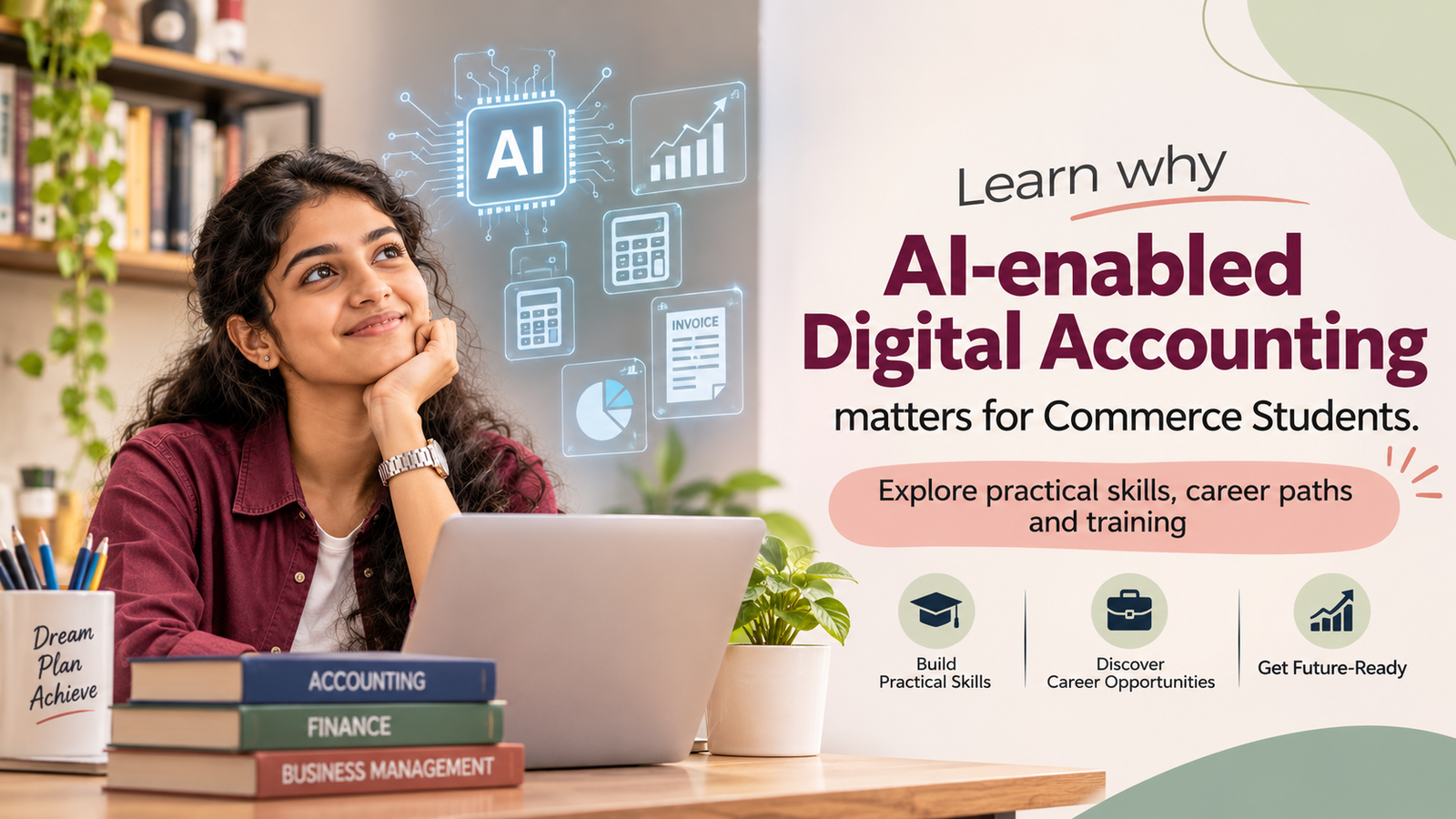
Why Commerce Students Should Learn AI-Enabled Digital Accounting
Commerce education provides a strong foundation in accounting, taxation, finance and business management. However, as businesses adopt digital tools and artificial intelligence (AI), the skills expected from accounting professionals are changing. Traditional accounting knowledge remains important, but students also benefit from learning how to use accounting software, automation tools and AI-assisted financial systems.
For commerce students planning to build a career in accounting, finance or business administration, learning AI-enabled digital accounting can help bridge the gap between academic knowledge and workplace requirements.
What Is AI-Enabled Digital Accounting?
AI-enabled digital accounting combines accounting principles, digital accounting software, automation and artificial intelligence to support financial activities. These technologies can help businesses organise financial records, process transactions, analyse data and prepare reports more efficiently.
For example, digital accounting software can record transactions, generate financial statements and assist with invoice management. AI-powered tools may also help extract information from invoices, identify unusual transactions and summarise financial data for review.
Although these tools can automate certain repetitive tasks, professional judgement, accuracy checks and knowledge of accounting principles remain essential.
1. Develop Skills That Match Modern Accounting Workplaces
Businesses increasingly use digital platforms to manage their financial information. Accountants may work with cloud-based accounting systems, digital invoices, automated reports and electronic financial records.
Commerce students who learn digital accounting alongside their academic subjects can become familiar with the tools used in modern accounting environments. Understanding how software supports bookkeeping, financial reporting and account reconciliation can also make it easier to adapt to different workplace systems.
Learning AI-enabled digital accounting helps students connect theoretical knowledge with practical accounting activities.
2. Reduce Repetitive Work Through Automation
Traditional accounting involves several routine activities, including entering transactions, organising invoices, recording expenses and preparing reports. Digital tools can automate some of these processes, depending on the software and the quality of the available data.
AI-enabled systems may assist with extracting invoice details, categorising transactions and identifying records that require further checking.
For commerce students, understanding these capabilities is valuable because future accounting roles may involve more supervision and verification of automated processes. Rather than relying entirely on manual data entry, students can learn how to use technology while checking that financial records remain accurate.
3. Improve Practical Accounting Knowledge
Studying accounting concepts is important, but applying them to realistic business situations develops a deeper understanding of the subject.
Practical digital accounting training can introduce students to activities such as:
- Recording sales, purchases, receipts and payments.
- Maintaining ledgers and managing accounts.
- Preparing bank reconciliation statements.
- Generating profit and loss statements and balance sheets.
- Organising invoices and expense records.
- Understanding GST-related accounting processes where applicable.
- Reviewing financial reports and identifying discrepancies.
When students combine these activities with AI-assisted tools, they can better understand how accounting processes operate in a digital workplace.
4. Build Career Opportunities in Accounting and Finance
Commerce graduates can pursue different career paths depending on their qualifications, practical skills and experience. Digital accounting knowledge can complement their education and help them prepare for roles involving financial records, reporting and business operations.
Relevant entry-level career paths may include:
Accounts Assistant: Helps maintain accounting records, process invoices and organise financial documents.
Junior Accountant: Supports bookkeeping, account reconciliation and the preparation of financial statements.
Accounts Executive: Assists with routine accounting operations, reporting and financial documentation.
Taxation Assistant: Supports tax-related documentation and calculations under appropriate supervision.
Payroll Assistant: Helps maintain employee payment records and process payroll information.
Accounting Software Operator: Uses digital accounting applications to record and manage financial transactions.
AI-enabled accounting skills can complement these roles, although employment requirements vary by employer. Students should also develop communication, analytical thinking and problem-solving skills.
5. Understand Financial Data and Business Decisions
Accounting is not limited to recording transactions. Financial information also helps businesses understand performance, manage expenses and plan for the future.
Digital accounting systems can generate reports that show revenue, costs, outstanding payments and other financial indicators. AI-assisted analysis may help identify patterns or highlight figures that need further investigation.
Commerce students who understand these reports can develop stronger analytical skills. They can learn to interpret financial information, ask relevant questions and communicate findings clearly.
It is important to remember that AI-generated insights may contain errors or overlook context. Financial decisions should be based on verified information and sound accounting knowledge.
6. Stay Prepared for Changes in the Accounting Profession
Artificial intelligence is changing how some accounting tasks are performed, but it does not remove the importance of professional expertise. Businesses still require people who understand accounting standards, taxation rules, compliance requirements and the context behind financial information.
As technology advances, accounting professionals may increasingly work alongside automated systems. Their responsibilities can include reviewing AI-generated outputs, resolving discrepancies, protecting confidential financial information and ensuring compliance.
Commerce students who understand both accounting fundamentals and digital tools can prepare themselves to adapt to these changes. Learning about data privacy, responsible AI use and the limitations of automated systems is also an important part of professional development.
7. Why Practical Training Matters for Commerce Students
Students may understand accounting theory but feel less confident when working with actual accounting software. Practical training helps them apply their knowledge to common business tasks and become familiar with digital workflows.
A structured digital accounting course can help learners develop experience in areas such as bookkeeping, financial reporting, accounting software and relevant taxation processes. Training that introduces appropriate AI tools can also help students understand where automation is useful and where manual verification is necessary.
When choosing a course, students should check the syllabus, software covered, practical exercises, trainer experience and relevance to current accounting practices.
Learn Digital Accounting with Inspiro Edutech
For commerce students who want to strengthen their accounting knowledge with practical digital skills, structured training can be a useful next step.
Inspiro Edutech offers digital accounting training designed to help learners understand accounting processes and develop relevant practical skills. Students can explore the course curriculum to understand the topics covered and how the training aligns with their career goals.
Visit the Digital Accounting course page at Inspiro Edutech to learn more about the available training.
Whether you are completing a commerce degree, have recently graduated or want to develop additional accounting skills, learning digital accounting can help you prepare for a workplace where technology plays an increasingly important role.
Conclusion
AI-enabled digital accounting is becoming an important skill area for commerce students because it connects accounting fundamentals with the digital tools used in modern businesses. From automating routine tasks to reviewing financial reports, these technologies are influencing how accounting work is organised and completed.
By learning accounting software, understanding AI-assisted processes and developing strong analytical skills, commerce students can build a more practical foundation for their careers. The most valuable approach is to combine technology with sound accounting knowledge, careful verification and professional judgement.
Starting with digital accounting training can help students take a practical step towards preparing for the evolving accounting and finance profession.

You may also like
How AI Is Transforming the Accounting Profession in 2027

How to Choose the Best Training Institute in Trivandrum for Your Career